Carefully worded Silences: Status on Manual Scavenging Abolition
- April 21, 2026
- 0
Everybody needs but nobody cares. what is status of the implementation of ms act 2013. Here we go.

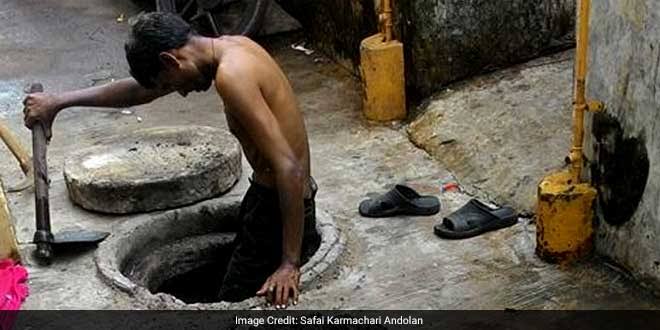
Every city has its invisible workforce. The ones who descend into sewers before sunrise, who clean septic tanks with bare hands, who carry the waste of a civilised society on their backs — quite literally.
India calls them Safai Karamcharis, sanitation workers, sewer and septic tank workers. Parliament, in a rare moment of acknowledgment, called them a subject worth questioning.
On March 17, 2026, Ms. Iqra Choudhary raised Unstarred Question No. 4031 in Lok Sabha, asking the Ministry of Social Justice and Empowerment some uncomfortable questions. How many manual scavengers are still waiting for rehabilitation? How many workers have died cleaning sewers since 2017? Has anyone been punished for making them do it?
The answers that came back were a mix of reassurance and carefully worded silences.
Numbers on Paper, Lives on the Ground
The government’s answer begins with the NAMASTE scheme — National Action for Mechanised Sanitation Ecosystem — launched in 2023-24 to ensure, as the document puts it, “safety and dignity” of sewer and septic tank workers. As of March 12, 2026, a total of 89,248 such workers and over 2.34 lakh Waste Pickers have been validated under the scheme. In Uttar Pradesh alone, 12,424 sewer workers and 35,641 waste pickers have been brought under its fold.
That sounds like progress. But read a little further and a different picture begins to take shape.
A fresh survey conducted across all districts found no manual scavengers. Yet, surveys conducted in 2013 and 2018 had identified 58,098 of them — including 32,473 in Uttar Pradesh alone. The government says all of them have been “rehabilitated” with a One Time Cash Assistance of Rs. 40,000 each.
Forty thousand rupees. Once. For a lifetime of degrading labour rooted in caste.
Skill development training was provided to 27,928 people, with a monthly stipend of Rs. 3,000 during the training period. A capital subsidy of up to Rs. 5 lakh was given to 2,679 individuals for self-employment projects. The state-wise breakdown in Annexure I shows Uttar Pradesh leading with 32,473 identified manual scavengers — more than any other state — with 18,289 receiving skill training and 879 getting capital subsidy.
622 Deaths. 52 Families Got Nothing.
Between 2017 and now, 622 sanitation workers lost their lives cleaning sewers and septic tanks across the country. Maharashtra recorded 82 deaths. Uttar Pradesh, 86. Delhi, 62. Tamil Nadu, 77.
Of the 622 families, 539 received full compensation. Twenty-five received only partial compensation. Fifty-two families received nothing at all. Six cases were simply closed.
In Uttar Pradesh’s district-wise breakdown, the numbers carry names of places most people only associate with temples and tourism. Ghaziabad — 18 deaths, all compensated. Gautam Budhnagar — 16 deaths, 8 compensated, 6 with nothing, 2 cases closed. Chandauli — 4 deaths, none compensated. Ambedkar Nagar — 2 deaths, none compensated.
It is one thing to die doing a job that machines should be doing. It is another to die, and have your family receive nothing in return.
Action Taken? That’s a State Subject.
When asked what action has been taken against contractors or civic bodies violating the mechanisation mandate, the government’s answer was brief: “Sanitation is a State subject under the VIIth Schedule of the Constitution of India. Data of action taken against contractors or civic bodies for violation of SOPs/guidelines on mechanisation is not maintained centrally.”
In other words — we don’t know. Or perhaps more accurately — we didn’t ask.
842 Complaints, 130 from UP
In 2025, the National Commission for Safai Karamcharis received 842 complaints from across states regarding non-payment of wages, denial of safety equipment, and caste-based discrimination. Delhi topped the list with 140 complaints. Maharashtra followed with 95. Uttar Pradesh filed 130 complaints.
The government, in its answer to part (e) of the question, states that “Sanitation is an occupation based activity rather than caste based.”
Perhaps that is the most telling line in the entire document.
The Measures Listed
The government lists several measures under NAMASTE — Personal Protective Equipment kits, occupational safety training, skill development, safety devices for Emergency Response Sanitation Units in larger cities, upfront capital subsidy, workshops on hazardous cleaning, pre-matric scholarships for children of sanitation workers, and health insurance under Ayushman Bharat.
These are not small things. On paper, they are a reasonable framework.
But between a policy listed in a Parliament document and a worker descending into a sewer in Chandauli at dawn — there lies a gap that neither a scheme name nor a budget allocation has yet managed to close.
622 deaths. 52 families compensated with nothing. One question in Parliament. And perhaps many more questions that still have no answer.